
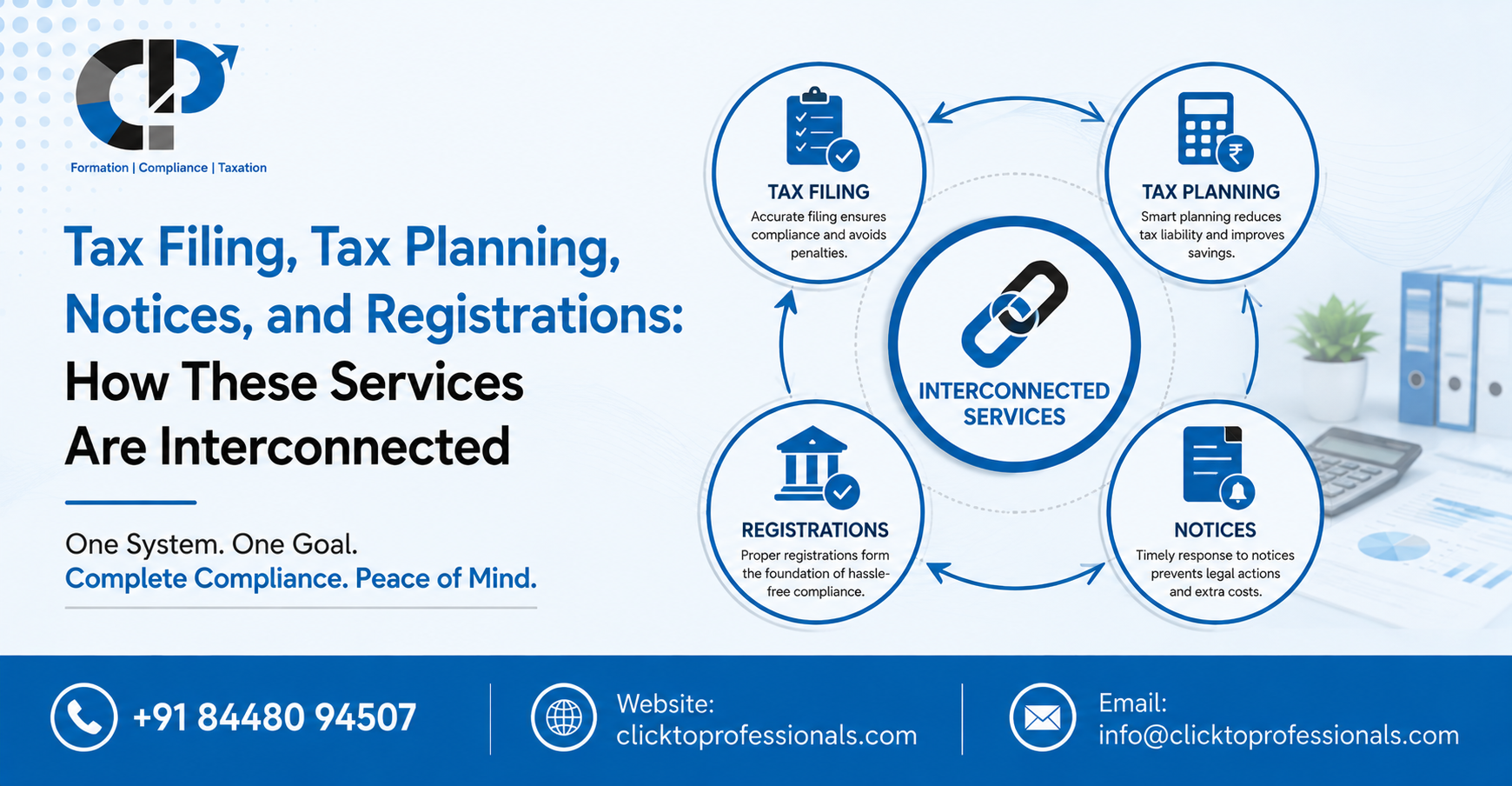
Managing taxes is an important part of every individual’s and business owner’s financial life. Many people think that tax filing, tax planning, tax notices, and registrations are separate services, but in reality, all of them are closely connected. Ignoring one area can create problems in another. Whether you are a salaried employee, freelancer, startup owner, or businessperson, understanding this connection can help you stay financially secure and legally compliant.
Today, with digital systems and online compliance becoming more common, services such as income tax filing, GST registration, tax planning, and responding to notices have become easier and more interconnected than ever before. A mistake in one process can affect another process directly. That is why it is important to understand how these services work together.
In this article, we will explain the relationship between tax filing, tax planning, notices, and registrations in simple and beginner-friendly language.
Understanding Income Tax Return Filing and Why It Matters
Income tax return filing is the process of reporting your income, deductions, taxes paid, and financial details to the Income Tax Department. Every eligible taxpayer in India must complete income tax filing within the prescribed due date.
Whether you are a salaried individual, business owner, freelancer, or professional, proper income tax return filing helps you:
- Stay legally compliant
- Claim tax refunds
- Avoid penalties and notices
- Apply for loans and visas easily
- Maintain financial records
Many people delay income tax filing because they think it is only about paying taxes. However, it is much more than that. Your filed return becomes an official financial document that connects with other services like GST registrations, business compliance, tax notices, and investment planning.
Proper income tax filing also helps create financial credibility. Banks, financial institutions, and government authorities often ask for ITR Filing documents during verification processes.
How Tax Planning Supports Income Tax Filing
Tax planning and income tax return filing are deeply connected. Tax planning means organizing your finances in a way that helps reduce tax liability legally.
Importance of Tax Planning Before Income Tax Filing
When taxpayers plan their taxes properly throughout the year, income tax filing becomes smoother and more accurate. Tax planning helps:
- Reduce taxable income
- Increase savings
- Claim eligible deductions
- Avoid last-minute mistakes
- Maintain proper documentation
For example, investments under Section 80C, health insurance under Section 80D, and home loan benefits can lower your tax burden significantly.
Common Tax Planning Tools Used During ITR Filing
Section 80C Investments
Investments such as PPF, ELSS, life insurance, and tax-saving fixed deposits help reduce taxable income.
Health Insurance Benefits
Medical insurance premiums paid for self and family can provide deductions under Section 80D.
Home Loan Benefits
Taxpayers can claim deductions on both principal and interest paid on home loans.
When taxpayers ignore tax planning, they often end up paying more taxes during income tax filing. Proper planning ensures better financial management and stress-free ITR Filing.
The Connection Between Registrations and Income Tax Filing
Registrations are another important part of the tax ecosystem. Many businesses and professionals need registrations such as GST registration, MSME registration, professional tax registration, or startup registration.
These registrations are directly connected with income tax filing.
Why Registrations Matter for Tax Compliance
Once a business is registered under GST or other tax systems, the government starts tracking business transactions digitally. The information filed under GST returns and other registrations is often matched with income tax filing data.
If there is a mismatch between GST turnover and income tax return filing records, taxpayers may receive notices.
GST Registration and Income Tax Filing
Businesses registered under GST must maintain proper invoices, sales records, and tax payment details. These details are later used during income tax filing.
For example:
- GST turnover should match business income reported in ITR Filing
- Input tax credit claims should be properly documented
- Expenses and profits should align with filed returns
This is why businesses should maintain accurate records throughout the year.
Professional Registrations and Tax Filing
Freelancers, consultants, and professionals may require registrations depending on their turnover and business type. These registrations help establish legal business identity and simplify income tax filing.
How Incorrect Income Tax Filing Can Lead to Notices
One of the biggest reasons taxpayers receive notices from the Income Tax Department is incorrect or incomplete income tax filing.
Tax notices are official communications sent by the department when discrepancies are found in returns, transactions, or financial records.
Common Reasons for Income Tax Notices
Mismatch in Income Details
If your reported income does not match Form 26AS, AIS, or TDS records, the department may issue a notice.
Errors During ITR Filing
Incorrect bank details, deduction claims, or missing income can trigger notices.
Non-Reporting of High-Value Transactions
Large financial transactions such as property purchases, stock investments, or high bank deposits are monitored closely.
GST and ITR Mismatch
Businesses often receive notices when GST turnover and income tax filing details do not match.
Importance of Responding to Notices Quickly
Ignoring tax notices can increase penalties and legal complications. A timely response with proper documents can usually resolve issues smoothly.
Tax professionals often help taxpayers:
- Understand notice reasons
- Prepare responses
- Submit supporting documents
- Correct filing mistakes
This is why accurate income tax return filing and proper record maintenance are extremely important.
How Digital Systems Have Connected Tax Services
The Indian tax system has become highly digital in recent years. Today, most tax-related services are connected through online portals.
When you e file income tax return online, the system automatically compares your information with:
- PAN records
- Aadhaar details
- GST filings
- TDS records
- AIS and Form 26AS
- Bank transactions
This interconnected system improves transparency but also increases the importance of accurate compliance.
Benefits of Digital Income Tax Filing
Faster Processing
Online income tax filing allows quicker verification and refund processing.
Better Transparency
Taxpayers can easily track return status, notices, refunds, and compliance history.
Reduced Paperwork
Most registrations, filings, and responses can now be completed digitally.
Easier Compliance Management
Businesses can manage GST, TDS, and income tax filing from integrated systems.
Because these systems are connected, errors in one filing can affect multiple areas.
Why Businesses Should Combine Tax Planning and ITR Filing
Businesses often make the mistake of treating tax planning and ITR Filing as separate tasks. In reality, both should work together throughout the financial year.
Benefits of Combined Tax Services
Better Financial Planning
Businesses can estimate taxes in advance and avoid cash flow problems.
Reduced Risk of Notices
Proper compliance reduces mismatches and reporting errors.
Accurate Profit Reporting
Correct bookkeeping and planning improve business transparency.
Easier Loan Approval
Banks prefer businesses with proper income tax return filing history.
Professional support helps businesses maintain compliance with registrations, tax filings, audits, and notices efficiently.
How Salaried Individuals Benefit from Proper Income Tax Filing
Even salaried employees should not ignore proper income tax filing and planning.
Key Benefits for Salaried Taxpayers
Faster Tax Refunds
Correct ITR Filing helps process refunds quickly.
Easy Visa Applications
Embassies often ask for income tax return filing documents.
Loan and Credit Card Approvals
ITR documents act as proof of stable income.
Better Financial Discipline
Regular tax planning encourages smart investments and savings.
Many salaried individuals also receive notices because of unreported freelance income, stock profits, or interest income. Proper tax filing prevents such issues.
Common Mistakes to Avoid During Income Tax Filing
Not Verifying Form 26AS and AIS
Always compare your records with official tax statements before filing.
Missing Deduction Claims
Many taxpayers forget to claim eligible deductions.
Filing Under the Wrong ITR Form
Choosing the wrong form can create complications.
Ignoring Notices
Never ignore communications from the Income Tax Department.
Delaying Tax Planning
Last-minute tax planning often leads to mistakes and missed opportunities.
Why Professional Guidance Matters for Tax Compliance
Tax laws and compliance rules keep changing. Professional experts help taxpayers manage registrations, tax planning, income tax filing, and notices together.
Experienced tax consultants can help with:
- Accurate income tax return filing
- GST and business registrations
- Tax-saving strategies
- Notice handling
- Audit support
- Compliance monitoring
This reduces stress and helps avoid penalties.
Conclusion
Tax filing, tax planning, notices, and registrations are all interconnected parts of a complete financial compliance system. Proper income tax filing does not only help you stay compliant but also supports smoother business operations, better financial planning, and reduced legal risks.
When taxpayers understand the relationship between registrations, planning, and ITR Filing, they can avoid common mistakes and maintain stronger financial health.
Whether you are an individual taxpayer or a business owner, staying proactive with tax planning, maintaining proper records, and completing accurate income tax return filing can save time, money, and unnecessary stress.
As India continues moving toward a fully digital tax system, the importance of proper compliance will only grow. Taking professional support when needed can help you file income tax returns smoothly and manage all related tax services efficiently.