The Income Tax Act 2025 has introduced several updates that every taxpayer in India should understand before starting their income tax filing process. Whether you are a salaried employee, freelancer, business owner, or pensioner, knowing the latest tax slabs, deductions, and filing structure can help you save money and avoid errors during income tax return filing.
With the government focusing more on digital compliance and simplified taxation, the new rules aim to make online tax return processes easier and more transparent. However, many taxpayers are still confused about what exactly has changed and what remains the same.
In this detailed guide, we will explain the important changes under the Income Tax Act 2025, updated tax slabs, the structure of the new and old tax regimes, and how these changes affect your income tax filing for FY 2025-26 and AY 2026-27.
Understanding the Income Tax Act 2025
The Income Tax Act 2025 is designed to modernize India’s taxation system and improve compliance. The government has focused on simplifying provisions, reducing complexity, and promoting digital income tax return filing.
Some major goals behind the updated structure include:
- Easier compliance for taxpayers
- Faster processing of refunds
- Increased transparency
- Encouragement of digital tax systems
- Simplified tax slabs under the new regime
For most individuals, the biggest area of interest is how the updated tax slabs and deductions impact their annual income tax filing.
Key Changes Introduced in Income Tax Act 2025
Several important changes have been introduced that directly affect taxpayers across India.
Simplified Tax Structure for Income Tax Filing
The government has continued promoting the new tax regime by simplifying slab structures and reducing confusion around rates.
Taxpayers now have:
- Lower tax rates in certain slabs
- Increased standard deduction benefits
- Easier compliance during income tax return filing
- Better online verification systems for online tax return
The aim is to encourage more individuals to shift toward the simplified tax regime.
Higher Focus on Digital Income Tax Return Filing
The tax department has significantly improved the digital filing ecosystem. The online tax return process is now:
- Faster
- More user-friendly
- Better integrated with AIS and Form 26AS
- Equipped with pre-filled data
This reduces manual errors during income tax filing and helps taxpayers complete returns quickly.
Improved Refund Processing
Refund timelines have become faster because of:
- Automated verification systems
- AI-based scrutiny selection
- Better data matching
Taxpayers completing accurate income tax return filing can expect quicker refund processing compared to previous years.
New Tax Slabs Under Income Tax Act 2025
One of the most important updates is the revised tax slab structure under the new tax regime.
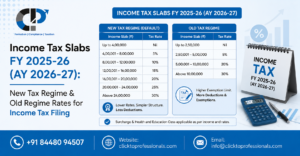
New Tax Regime Slabs for FY 2025-26
| Annual Income | Tax Rate |
| Up to ₹4 lakh | Nil |
| ₹4 lakh – ₹8 lakh | 5% |
| ₹8 lakh – ₹12 lakh | 10% |
| ₹12 lakh – ₹16 lakh | 15% |
| ₹16 lakh – ₹20 lakh | 20% |
| ₹20 lakh – ₹24 lakh | 25% |
| Above ₹24 lakh | 30% |
These revised slabs are expected to benefit middle-class taxpayers during income tax filing.
Standard Deduction Benefit
The standard deduction remains available for salaried employees and pensioners under the new regime.
This helps reduce taxable income and simplifies income tax return filing for salaried individuals.
Old Tax Regime vs New Tax Regime
Many taxpayers are confused about which regime to choose during income tax filing.
Old Tax Regime Benefits
The old regime continues to offer:
- Section 80C deductions
- Home loan interest benefits
- HRA exemption
- Medical insurance deduction under Section 80D
- Education loan benefits
This regime is beneficial for taxpayers with higher investments and exemptions.
New Tax Regime Benefits for Online Tax Return
The new regime offers:
- Lower tax rates
- Simplified structure
- Fewer calculations
- Faster online tax return filing
It suits individuals who prefer minimal paperwork and fewer investment-linked deductions.
Which Regime is Better for Income Tax Return Filing?
The answer depends on:
- Your salary structure
- Investments
- Home loan status
- Eligible deductions
Taxpayers should compare both regimes before completing income tax filing.
Important Structural Changes in Income Tax Filing
The Income Tax Act 2025 has also brought structural improvements.
Pre-Filled Data in Online Tax Return
Taxpayers now receive more pre-filled information such as:
- Salary details
- Bank interest
- TDS information
- Mutual fund transactions
This reduces mistakes during income tax return filing.
Better AIS Integration
The Annual Information Statement (AIS) has become more detailed and accurate.
It helps taxpayers verify:
- Financial transactions
- Tax deductions
- Investment records
Matching AIS data before income tax filing is now extremely important.
New Compliance Rules in ITR Filing
The government has introduced stricter compliance checks.
Mandatory Reporting of Foreign Assets
Taxpayers holding foreign assets or overseas income must disclose them properly during income tax return filing.
Non-disclosure can lead to penalties.
High-Value Transaction Monitoring
Large transactions are now closely monitored through:
- PAN linkage
- Banking records
- AIS reporting
Incorrect reporting may trigger scrutiny notices during income tax filing.
Benefits of Online Tax Return Filing Under the New System
The government is strongly promoting digital filing systems.
Faster Verification Process
E-verification through:
- Aadhaar OTP
- Net banking
- Digital signature
has made online tax return filing much quicker.
Reduced Paperwork
Taxpayers no longer need to submit physical documents in most cases.
This simplifies the overall income tax filing process.
Better Transparency
The new portal allows taxpayers to:
- Track refunds
- Respond to notices
- Download filed returns
- View tax credits
All these features improve the overall income tax return filing experience.
Common Mistakes to Avoid During Income Tax Filing
Even with simplified systems, many taxpayers still make errors.
Incorrect Selection of Tax Regime
Choosing the wrong regime can increase your tax liability.
Always compare both regimes before income tax filing.
Ignoring AIS and Form 26AS
Mismatch between filed returns and government records can result in notices.
Always cross-check all data before submitting your online tax return.
Missing Filing Deadlines
Late income tax return filing may result in:
- Penalties
- Interest charges
- Delayed refunds
Timely filing is extremely important.
Who Will Benefit Most From the Income Tax Act 2025?
The revised structure mainly benefits:
- Salaried employees
- Young professionals
- First-time taxpayers
- Individuals preferring simplified taxation
The new system especially helps those who do not claim multiple deductions during income tax filing.
Tips for Smooth Income Tax Return Filing
To ensure hassle-free filing:
- Keep PAN and Aadhaar linked
- Verify Form 16 carefully
- Check AIS data
- Maintain investment proofs
- File returns before the due date
- Choose the correct regime
These steps can make your online tax return process smoother and error-free.
Final Thoughts on Income Tax Act 2025
The Income Tax Act 2025 is a major step toward simplifying India’s taxation system. The revised tax slabs, digital integration, and simplified compliance rules are expected to make income tax filing easier for millions of taxpayers.
At the same time, taxpayers must remain careful about accurate reporting, AIS reconciliation, and timely income tax return filing. Choosing the right tax regime is also essential to maximize tax savings.
As digital systems continue to improve, the future of online tax return filing in India is becoming faster, smarter, and more transparent. Understanding these changes today can help taxpayers avoid confusion and file returns confidently in the coming financial years.